This swathe of southern Wales is divided into four distinct areas of
high ground by the rivers Usk, Taf and Tawe. These rivers, here in their
enthusiastic infancy, descend to meet the salt water of the Bristol
Channel by the three great cities of the south, Newport, Cardiff and
Swansea respectively.
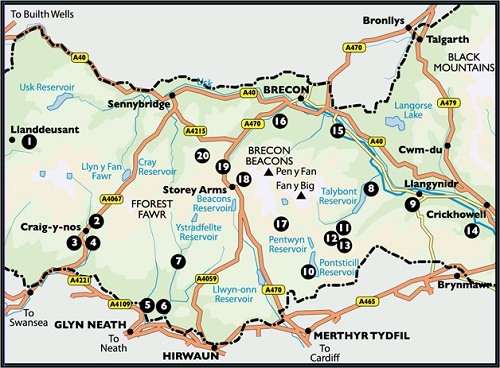
Strictly speaking the term ‘Brecon Beacons’ applies to the central area
of the Park, just south of Brecon. In particular, to the three or four
highest peaks, crowned by Pen y Fan. At 886 metres its distinctive cap
is the highest land in southern Britain and only just fails to break
through the magic 3000 feet mark. These sandstone peaks are buttressed
by a series of high ridges nurturing the infant waters of the Taf to the
south and tributaries of the Usk to the north. The phrase ‘Central
Beacons’ is sometimes used to distinguish this area from the entire
National Park that extends much further.
However, there are two further mountain blocks westwards from here.
These are more remote and relatively undiscovered. To the west is
Fforest Fawr, a wild expanse of upland that stretches from the A470 to
the pass between the headwaters of the Tawe and Usk.
Beyond this, to the far west, the Black Mountain covers a vast expanse
of remote and lonely moorland beyond the sources of the Tawe and Usk. It
rises to a remarkable serrated edge that stretches for over five miles,
known as the ‘Carmarthen Fan’.
This new edition of this guidebook covers these central and western
areas of the National Park. Another Kittiwake guide, ‘Walking in the
Black Mountains’, covers the eastern mountain range. These summits and
high moorland cocoon a sequence of wooded valleys as far as the final
ridge on the English border.
This is a wonderful area to walk, with a huge variety of scenery and much of interest. Enjoy it!