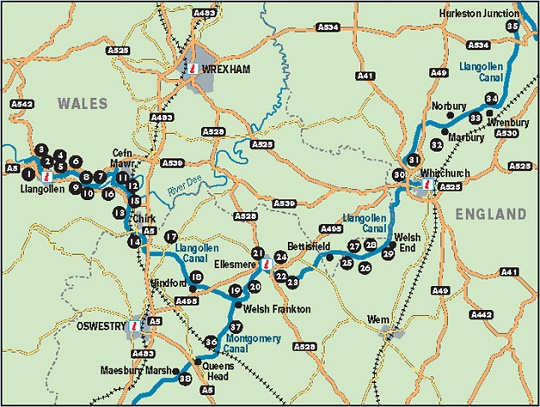
It passes through the stunning Vale of Llangollen, enclosed by hills and
now part of a designated Area of Outstanding Natural Beauty, then
crosses north Shropshire, with its glacial meres and rare raised mosses,
to the junction with the main Shropshire Union Canal in south Cheshire.
The narrow canal was designed by William Jessop and Thomas Telford, the
greatest civil engineers of that era. Its most spectacular 11 mile
section from Horseshoe Falls to bridge 19 at Chirk Bank, featuring two
stunning aqueducts and tunnels, was awarded World Heritage Site status
in 2009. Its centerpiece is Telford’s Pontcysyllte Aqueduct, described
as a ‘masterpiece of creative genius’.
The canal was originally part of the Ellesmere Canal, an ambitious
scheme launched in 1793, to create a commercial waterway linking the
river Mersey, from what became Ellesmere Port, to the river Dee at
Chester and the river Severn at Shrewsbury. Its aim was to serve the
mineral industries of north east Wales, West Midlands manufacturing
centres, and distribute lime as a fertiliser to enrich farmland in
Shropshire. By 1805 only part of the canal system had been completed and
the plan to extend south from Chester to Trevor was abandoned, as was
the final nine miles into Shrewsbury.
A new feeder source was needed so the canal was extended to the Dee near
Llangollen in 1808. It was also decided to join the canal with the
Chester Canal at Hurleston. In 1845 it became part of the wider
Shropshire Union Canal system.
Goods carried included coal, iron, limestone, lime, timber, grain, and
cheese. Traffic peaked in the mid-19thC, but had ceased by the late
1930s. The canal survived formal closure in 1944 mainly because it fed
water to Hurleston reservoir. It was later renamed the Llangollen Canal
and is now one of the most popular canals in Britain, with an estimated
15,000 boat trips along it each year. Ironic really, since Llangollen
was not included in the original plans!
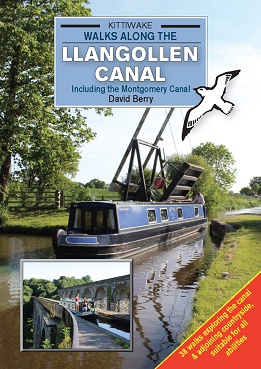
This book comprehensively explores the canal, its history and the
adjoining countryside, visiting places of interest. It contains 29
circular walks plus 9 linear walks linked to local buses and a heritage
railway. Three walks feature the connecting restored section of the
scenic Montgomery Canal. Many feature canalside or country pubs, and
tea-rooms. The routes range from a 1¾ mile stroll around Cole Mere in
Shropshire to a 11 mile linear World Heritage Site walk. A key feature
is that routes can easily be linked with others to provide longer day
walks, if required. A rich and varied area for walking.