Call: 0333 335 5474
Basket: £0.00 | 0 items

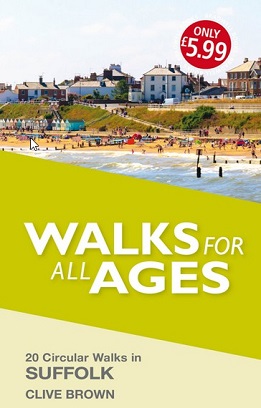
Walks for all Ages: Suffolk

Walks for all Ages: Suffolk

Describing the local area at the start of each walk, the author then provides a detailed description of the walk with snippets of information as you go along.

Including Ordnance Survey mapping and superbly priced at just £5.99, Walks for all Ages - 20 Circular Walks Suffolk is the perfect accompaniment for a stroll in the county.

Introduction

In Suffolk the going for walkers is usually easy, as mountains or indeed hills are not a common feature within the county. Paths, gates and stiles are usually well maintained with good surfaces, although there is always a short period when ploughed fields may need to be crossed when fields are under cultivation. The highest point of the county is 420 feet (128 metres), at Rede to the south-west of Bury St Edmunds.

Historically the county of Suffolk derives from the Kingdom of the East Angles, occupied by the ‘South Folk’. It is difficult to tell when the counties of Norfolk and Suffolk separated, but they were certainly regarded as different counties within the Doomsday Book of 1086. Complicated local government areas known as hundreds, liberties and honours were simplified in 1860 by divisions centred on Bury St Edmunds and Ipswich. In 1890 these became the separate counties of East Suffolk and West Suffolk. The county was reunified in 1974; it had originally been intended at this time to transfer Haverhill and the awkward lump of Suffolk surrounding Newmarket into Cambridgeshire. Colchester too was initially going to be brought into Suffolk, but in the end neither change happened and the county has retained most of its ancient territory. The biggest centre of population is Ipswich; Bury St Edmunds rates only third behind Lowestoft.

Suffolk has, however, lost a great deal of its coastline and the speed at which the land in some locations disappears into the sea has been a constant problem through history. The low cliffs north of Southwold have been eroded by close to half a mile during the 19th and 20th centuries. Large areas of the county near the coast lie within the Suffolk Coast and Heaths Area of Outstanding Natural Beauty (AONB). The area also contains the RSPB Minsmere reserve, other National Nature Reserves (NNRs) and several Sites of Special Scientific Interest (SSSIs).

In Suffolk there are at least forty examples of crinkle crankle walls. A good example runs by the side of the road in Eye. The walls are only one brick thick but are immensely strong because of the continuous waves of opposite curves. Very often even the most unsophisticated farmhouses in the county have surrounding moats. Historically moats were dug around castles and fortified buildings as a first line of defence, but most of the moated houses in Suffolk were built long after this form of security was needed. The cheapest and easiest way to build a large house was to dig out the clay on site and bake the bricks in an adjacent temporary oven, and it was quickly realised that the resulting hole had added value as a convenient reservoir for water. The holes then began to be dug around the property as a decorative feature and a reason that they could feel slightly superior to their neighbours.

Towns and villages throughout the county are goldmines for students and enthusiasts of the art of pargeting. The plasterwork panels between the studs (wooden struts) of half-timbered, wooden frame houses are decorated with relief or 3D designs. The buildings are often adorned with abstract arrangements and repeated geometrical shapes. The artwork on the houses of the particularly well to do feature animals, human figures, birds, flowers and leaves. Grapes and grapevines in a frieze were particularly popular and the artwork sometimes covers the whole of the first-floor walls of a building. Simple designs were made using just a shaped piece of wood, while more complex shapes were made with fingers and templates or occasionally with pre-shaped sections.

Featured Walks 

Walk 01. Bradfield Woods National Nature Reserve - 2½ miles
Walk 02. Bury St Edmunds - 2½ miles
Walk 03. Clare Common - 3 miles
Walk 04. Dedham Vale - 4 miles
Walk 05. Dunwich Forest - 3 miles
Walk 06. Eye Priory - 3½ miles
Walk 07. Gull Stream - 5½ miles
Walk 08. Hinderclay Fen - 6 miles
Walk 09. Kentwell Park - 4 miles
Walk 10. Kersey Vale - 4¼ miles
Walk 11. Lavenham - 4¼ miles
Walk 12. Livermere Park - 3 miles
Walk 13. Minsmere - 5½ miles
Walk 14. Polstead - 4¼ miles
Walk 15. Southwold Harbour - 3½ miles
Walk 16. Sudbury and the Stour - 3¼ miles
Walk 17. Sutton Hoo - 3½ miles
Walk 18. Tunstall Common - 3 miles
Walk 19. West Stow - 4 miles
Walk 20. Woolverstone Park - 3½ miles

ISBN 9781910551820
 
OUR PRICE: £5.99
 
Quantity
 
Delivery Info  
Flat rate £2 postage on all items/orders up to £19.99 Free Delivery on orders over £20


Know someone who'd like this? Tell them about it...

*
*
*
Shopping with us is safe and secure
Copyright © Walking-books.com All rights reserved Created by White Room Creations T&C’s I Privacy Policy